The LifeStorm: Why You Feel Different - and What’s Really Happening
What’s a LifeStorm?
A LifeStorm is a disorienting time when something happens to upend your life. It's a situation you’re pushed into, either involuntarily or voluntarily, and must face head on.
This destabilising time is something your mind finds impossible to figure out as it can’t be ignored, reasoned away, or talked out either.
Whilst a LifeStorm can happen a number of times in a lifetime, it can commonly arise in midlife.
What’s happening
When a LifeStorm shows up, it can feel like the old version of you is falling away. And it can feel deeply uncomfortable when it does.
Essentially, something is changing inside you and you’re in a gap - between the old you and the new.
This gap is like a no man’s land, surrender space. It has a sense of lostness about it which you mustn’t judge, suppress, ignore, or hate. Because the more you accept and fold yourself into the situation, the better.
I came to see my own LifeStorm as a course correction - something that ultimately changed me for the better. You may come to understand yours differently.

What a LifeStorm can feel like
It can feel different for everyone, but there’s certain feelings that tend to show up repeatedly when you’re going through one.
You might suddenly feel detached from your old life. Things that used to feel spot on, don’t anymore. The life you’ve carefully created still exists… but something inside you has completely changed.
Or you might feel emotionally shot to pieces from holding everything together for so long. Or restless… like a wild animal is trying to break free from inside, but you can’t fully explain what on earth it is yet.
Some people feel numb and have to poke themselves to check they’re still really here. Others feel overwhelmed as it’s too much to process in their heads.
You might want to disappear for a while. Put on your invisibility cloak and spend more time alone. Because certain people, conversations or environments suddenly have an energy vampire vibe about them.
You can start feeling different around old friends, family members or work colleagues too. Like you don’t fully fit in the same way anymore whilst everyone around you has stayed the same.
A lot of people start craving something more real during this stage as well. More meaning, honesty, purpose, and connection to themselves.
You can also find yourself questioning everything. Your relationships, work, lifestyle, beliefs, who you are, and what you want now. Who am I now really?
And underneath all of that there can be grief too. A sad longing for the old version of you, for the time you wasted surviving or shapeshifting into who you thought you needed to be, or for the parts of yourself you lost along the way.
It can feel damn lonely. Especially when you can’t fully explain what’s happening inside you to the people around you.
And one of the hardest parts is not knowing what comes next. You know something is changing, you can feel it, but you can’t fully see the path ahead yet. And that in-between space can feel deeply uncomfortable.
I know this territory well, because I went through it myself in my early forties.
From the outside life looked normal, but internally everything was going bananas. For a while I genuinely thought I might be going mad - until I realised I was moving through a deep internal transition.
What causes a LifeStorm?
It can be caused by all sorts of things. Here’s some examples:
Something’s been taken from you, and you’re experiencing loss and grief – perhaps someone close to you has died, a long-term relationship has ended in divorce, or you’re being made redundant from your job.
You no longer fit in with friends, family members, co-workers – perhaps there’s toxicity and you’re disconnecting from the very people you used to enjoy hanging out with. And now you feel lost and stuck.
You’ve reached a quarter-life or midlife stage where the old version of your life no longer fits in the same way.
You’re facing up to, or overcoming, an addiction or coping mechanism that’s been affecting your health. For example, alcohol, smoking, drugs, emotional eating, drama, or toxic relationships.
The beliefs you’ve held are crumbling – whether political, spiritual or lifestyle based. Maybe you want to get out of the money chasing corporate rat race, or you feel you’re not living up to your full potential and need to do something about it.
You’ve experienced burnout, crisis, a breakdown or trauma.
Why people get stuck
People often get stuck because instead of letting the current of change take them, they try to swim against it.
They try to force themselves back into the old ways of being.
But the previous self is the very thing that’s falling away.
So, people tend to panic, overthink, rush decisions. They try to fix things on the outside or outrun what’s happening by staying busy. They disappear into work, pour more wine, endlessly scroll reels, raid the kitchen cupboards… whatever their coping mechanism is.
Because sitting in the gap between the old you and the new you can feel deeply uncomfortable.
The mind wants certainty and answers. It wants things to go back to how they were before. But a LifeStorm rarely lets us do that.
So this part of the process is about learning how to sit with yourself long enough to understand who you’re becoming. And not set fire to everything in your life whilst things rearrange on the inside.
The LifeStorm Map

Over time, I've noticed people tend to move through recognisable stages during major life transitions like these.
Not everybody experiences every stage in the same way, and people can move backwards and forwards between them, but many people find it incredibly reassuring to see there’s a pattern to what they’re going through.
Because when you’re in the middle of a shift like this, it can feel random, frightening and blinkin’ personal.
But often…there’s a process unfolding beneath the surface.
There tends to be:
a shaking of the old life
a period of resistance and uncertainty
a difficult in-between space
and eventually, the gradual emergence of a new way of being.
Understanding where you are within that process can make the experience feel far less frightening.
Moving through a LifeStorm
Although every LifeStorm is different, I've found there's typically 3 phases.
1. End Game. Something is coming to an end. That doesn’t necessarily mean your job, relationship or life as you know it is ending — although sometimes an external change is the catalyst. Often it’s an inner ending. An old way of seeing yourself, living your life or understanding the world no longer fits in quite the same way. This is where disruption and resistance tend to show up as you try to make sense of what’s happening and get back onto solid ground.
2. In Between. The old is loosening, but the new hasn’t formed yet. This can be the strangest part of a LifeStorm because there may be nothing obvious to do. Rather than looking outside yourself for answers, this phase asks you to turn inward. It’s a time for surrender, letting go of what no longer fits, getting to know yourself underneath the roles, beliefs and expectations you’ve accumulated, and allowing something different to begin to emerge.
3. Step Out. Eventually, what has been changing on the inside starts to make its way into your everyday life. You begin making different choices, setting different boundaries and living more from what feels genuinely true for you. It can feel wobbly at first — a bit like breaking in a new pair of shoes — but over time you begin to trust yourself more and move forward on a path that feels much more like your own.
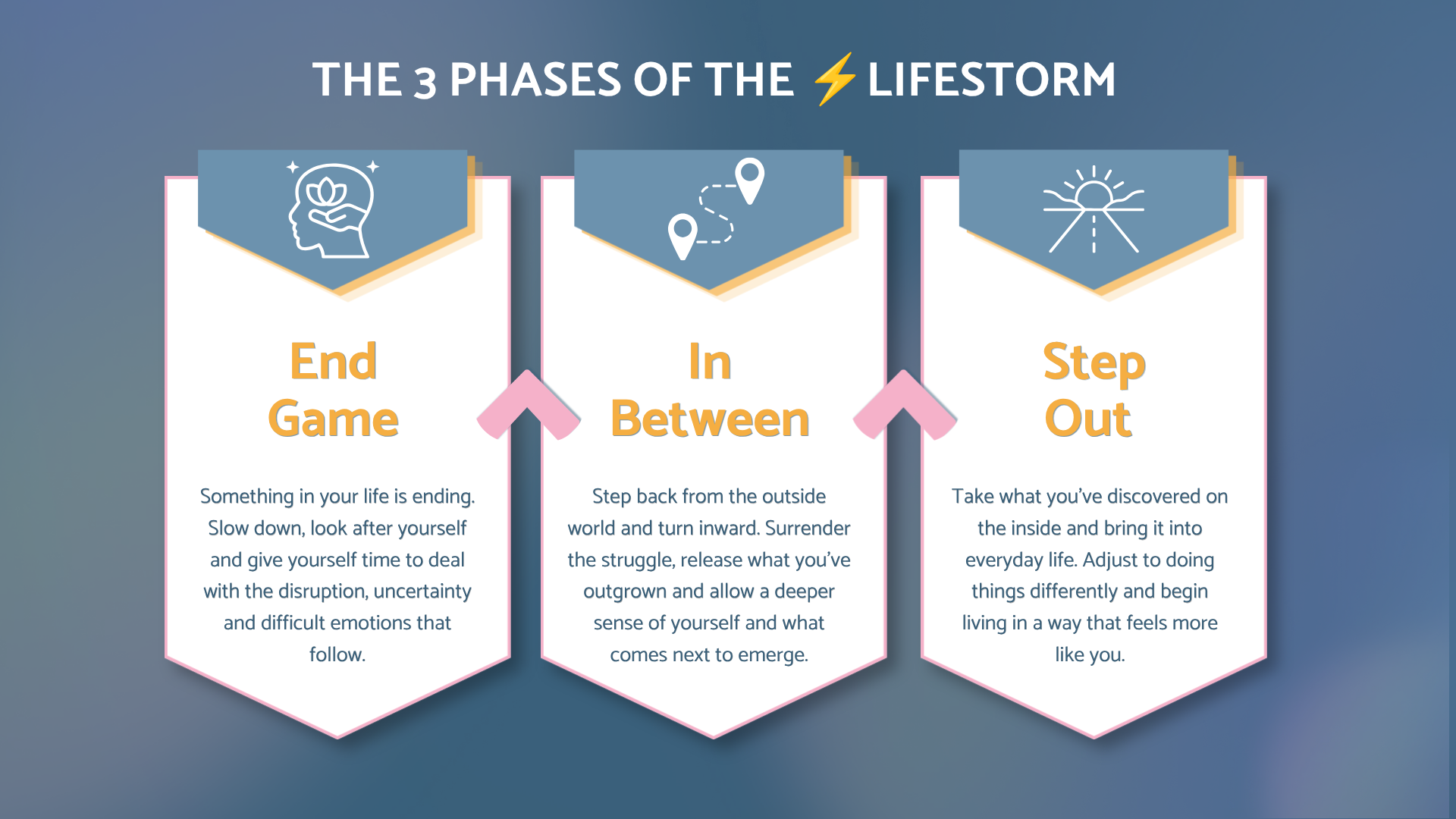
It isn't a neat, linear process. You can move backwards and forwards, revisit old stages and shed another layer along the way. But the overall movement is from looking outside yourself for answers to developing a much stronger sense of who you are and what feels true for you.
About Carrie
Carrie Druce supports people through stress, anxiety, life transitions and deep periods of inner change.
After navigating her own major shift in midlife, she now helps others steady themselves through the uncertainty that can arise when life starts changing from the inside out.
Need more LifeStorm support?
Sometimes people don’t need all the answers straight away.
They just need help understanding where they are.
That’s the purpose of my The LifeStorm Map session - a Zoom conversation designed to help you make sense of what’s shifting and explore what may help at the stage you’re in.